

US Government Seeks Regulatory Solutions for Tax and Data Gaps, Customs Brokers Under Scrutiny
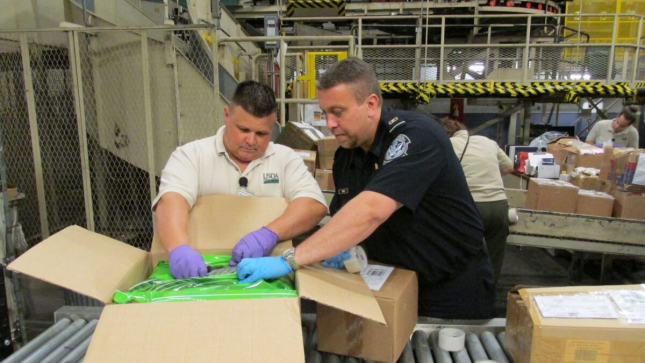
Image Source: U.S. Department of Agriculture, Erich Glasgow
PART 01: Multiple Companies' T86 Filing Qualifications Revoked
Recently, the U.S. Customs and Border Protection (CBP) suspended several customs brokers' qualifications, primarily those accelerating the entry of low-value goods and facilitating the surge of e-commerce imports from China and India. Currently, CBP is working hard to regulate these imported goods.
In the suspension announcement, CBP did not provide detailed specifics but hinted that intermediaries were penalized for failing to comply with the requirement for importers to use "reasonable care" to properly classify and value goods and for delayed submission of required information.
According to the 2016 update of U.S. trade regulations, the retail value of goods that can be imported duty-free per person per day (without detailed, formal customs declarations) was raised to $800 from the previous threshold of $200.
Trade compliance experts indicate that the change in the de minimis threshold was to accommodate the growing demand for online shopping and direct home delivery while also recognizing that the duties on low-value imports are so low that it is not worth CBP's resources to collect them. After the rule change, Chinese e-commerce platforms like TEMU and SHEIN sparked a wave of immediate packages in the U.S., overwhelming CBP's ability to identify suspicious packages and issuing warnings that smugglers of counterfeit and other illicit products are exploiting this process.
A November 2023 report by the International Trade Commission found that, by volume, so-called Section 321 goods accounted for a significant portion of all e-commerce imports in the U.S., with China being the primary source of duty-free imports, leading by far.
According to CBP data, the agency handles nearly 4 million low-value goods daily. Through postal, express, and non-express facilities, the number of low-value transactions soared by 646% in eight years, from 134 million in FY 2015 to 1 billion in 2023 (valued at over $50 billion). The International Trade Commission predicts this number will exceed these totals this year.
When the vast majority of imports are primarily business-to-business shipments, facilitated by a few hundred large consignees, trade facilitation becomes more manageable. Most goods arrive in the U.S. via commercial airplanes and container ships, with some inventory stored in warehouses in Canada and Mexico, transported to the U.S. by land when consumers place orders.
To enhance visibility and further expedite border clearance processes relying on limited carrier manifest data, CBP launched a voluntary T86 program test in 2019 for self-filers and customs brokers to electronically transmit shipment data through its trade processing platform. A key advantage of T86 is that it covers goods under the import jurisdiction of other agencies (such as the Food and Drug Administration), which require additional data elements. To expedite processing, filers must provide more data, including a 10-digit Harmonized Tariff Schedule code.
Freight forwarders and customs brokers can profit if they can handle inbound goods in bulk but assume greater risk because if shippers or logistics companies hire them to handle T86, they must declare themselves as importers of record and take reasonable care rather than merely acting as responsible customs brokers exercising oversight and control.
CBP Acting Commissioner Troy Miller stated in a declaration: "CBP's assessment and suspension of ineligible T86 participants is part of a multi-layered enforcement approach to prevent abuse of the de minimis process, protect supply chain integrity, and ensure businesses comply with applicable U.S. legal requirements. When businesses fail to comply with U.S. laws, it can profoundly impact the integrity of our trade system and those who rely on goods flowing through our ports daily. Any suspended brokers who demonstrate to CBP that they have developed and implemented a remedial action plan will be considered for reinstatement."
According to The Information, Seko Logistics is one of the companies under investigation by CBP, banned from participating in the T86 program for at least 90 days. Seko Logistics responded in a declaration that it has nearly 100% compliance and is now suing CBP in federal court, demanding an explanation for the suspension.
In court filings, Seko Logistics stated that despite repeated requests and threats of legal action, CBP never provided details on its violations. Seko is also seeking an injunction to cancel any rejoining conditions until specific violations leading to CBP's enforcement actions are identified, stating it remains committed to seeking full and unconditional reinstatement of these agreements, as CBP took unprecedented enforcement action without identifying specific violations. Considering the company's compliance rate of over 99.9999%, the declaration also questioned whether any violations existed.
News reports indicate that six to seven freight forwarders or brokers' T86 filing qualifications have been revoked by CBP.
PART 02: What Triggered the Strict Scrutiny of T86 Clearance?
In the past two years, fast fashion brand SHEIN and e-commerce platforms TEMU and AliExpress have become major catalysts for the air freight industry, helping the sector accelerate its recovery from the post-pandemic slump. According to some logistics service providers, e-commerce goods account for 50% of all air freight exports from China.
Lenny Feldman, an executive partner at the trade law firm Sandler, Travis & Rosenberg, said that raising the duty-free threshold to $800 opened the door for more e-commerce, but the growth of online shopping truly took off when people changed their shopping habits during the pandemic, as the average low-value shipment was still only about $50 to $60.
The biggest trigger currently is e-retailers realizing that they can avoid paying tariffs by splitting shipments instead of consolidating them into warehouses. This allows each consumer to be treated as a separate consignee, opening the door to direct shipping from the country of origin instead of shipping to registered importers with warehouses.
In mid-April, trade compliance professionals warned that CBP was rejecting more cross-border e-commerce shipments, changing the automated declaration system, and mandating T86 transactions be submitted before or upon arrival of the imported goods.
Previously, T86 declarations could be made within 15 days after the product arrived. The current update means brokers must submit a complete, accurate, and timely dataset, including a full product description and a unified tariff code. Declarations submitted after the goods arrive will be rejected and held until a separate or proper declaration is made, making the goods ineligible for expedited clearance.
Laurie Cieciuch, an executive at Hurricane Commerce, stated: "Failure to meet the new T86 requirements could result in brokers managing a large volume of formal and informal entries, which is very labor-intensive and time-consuming, ultimately impacting their clients and end consumers."
At the April 19 annual meeting of the National Customs Brokers and Freight Forwarders Association of America, CBP Acting Commissioner Troy Miller urged the trade community to provide more high-level data on low-value goods and stop listing vague or inaccurate descriptions on manifests. In many instances of T86, we see many filers failing to verify the accuracy of the data they submit, along with unreasonable weight-to-value ratios, various goods, or vague descriptions of daily necessities.
Some filers abuse their T86 declaration tests by submitting declarations as quickly as possible and providing junk data. These individuals can submit thousands of dollars' worth of declarations daily without reviewing the data for accuracy. CBP has learned that these filers charge as little as 10 cents per T86 transaction.
As a result, highly compliant brokers do not participate in the test because they cannot fulfill the responsibility of providing accurate data to CBP, making it impossible to compete with these prices. This creates unfair competition in the T86 test environment.
To change this situation, CBP is stepping up enforcement to ensure compliance and responsible customs brokers' participation in the T86 test.
Image Source: FreightWaves
Lenny Feldman stated that to comply with regulations, brokers need to invest in knowledgeable staff and technology, reflecting in the prices they charge. Businesses need automation and AI to check data anomalies, examine vague data descriptions, assist in HTS classification, and a human resources component to ensure enough personnel to review and brainstorm when the system detects anomalies, then say, "Hey, this is something that needs to be re-examined and resolved."
Karen Lobdell, a senior manager at Thomson Reuters' global trade automation platform, said CBP is purchasing software to help analyze and target small shipments but does not have enough resources to inspect most packages.
Lobdell added that CBP is pushing the industry to provide more data because they cannot target based on vague descriptions. Express carriers like FedEx and UPS are participating in data pilots, providing CBP with more data than T86 entries in exchange for faster clearance.
PART 03: Differing Opinions on Eliminating the De Minimis Threshold
E-commerce has also received significant attention from the U.S. For example, a U.S. Senate proposal would ban Chinese export products from entering the U.S. through the de minimis channel and require an equivalent duty-free threshold for U.S. export products, similar to what U.S. exporters receive in other countries. They believe legislation will effectively eliminate the de minimis treatment for Chinese imports and require CBP to collect more information on low-value goods.
However, trade practitioners question the feasibility of setting different minimum standards for each country.
According to the E-Merchants Trade Council (EMTC), it is conservatively estimated that cancelling the minimum threshold for goods from China will increase the total cost of imported goods by more than $110 billion annually. Assuming a declared value of $50 for a product, e-commerce sellers would need to pay an additional $61.25 in costs, including product processing fees and customs broker fees, for formal customs clearance. A product priced at $50 might retail for $75, resulting in losses for sellers. Small businesses operating on e-commerce platforms like Etsy have low profit margins and are highly cost-sensitive, making it difficult for many retailers to sell products online with additional fees.
EMTC understands that the U.S. Congress is very concerned about several issues related to Chinese imported goods, but we remind Congress not to confuse these issues with minimum duty-free goods, as these issues also pose challenges to multinational corporations importing Chinese goods. Moreover, cancelling minimum restrictions on imports from specific countries will invite similar responses to U.S. exports. For example, the EU plans to cancel the minimum tariff of €150 ($163), which will negatively impact U.S. exporters.
Lenny Feldman predicts that Congress will not change the $800 minimum threshold but may restrict or prohibit small-value goods from China from receiving this benefit.
Last month, EMTC suggested that CBP and the U.S. Postal Service pilot a project to create risk profiles for e-commerce sellers shipping low-value parcels, which would help Customs and Border Protection focus enforcement resources on unreviewed business goods. Risk profiles would be helpful because in e-commerce, there is no physical importer, and customs will ultimately hold third-party marketplaces accountable for any violations.
The minimum duty-free part is very important, and we cannot demonize service providers who require different data elements based on different shipping methods, but guidance, transparency, and a fair competitive environment are needed. Whether it is full consumption at entry, formal minimum duty-free (T86), or others, the same data requirements are needed so that everyone has the same expectations for buyers and sellers, unified tariff tables, and commercial invoices, eliminating the need to stop brokers.
This article is authorized by: Cross-border e-commerce logistics expert, translated and edited by: Esme
Source: "US Customs tightens enforcement on low-value e-commerce trade"
The above content is sourced from the Internet, and the article only represents the author's views, not the platform's stance.